
Angioplasty

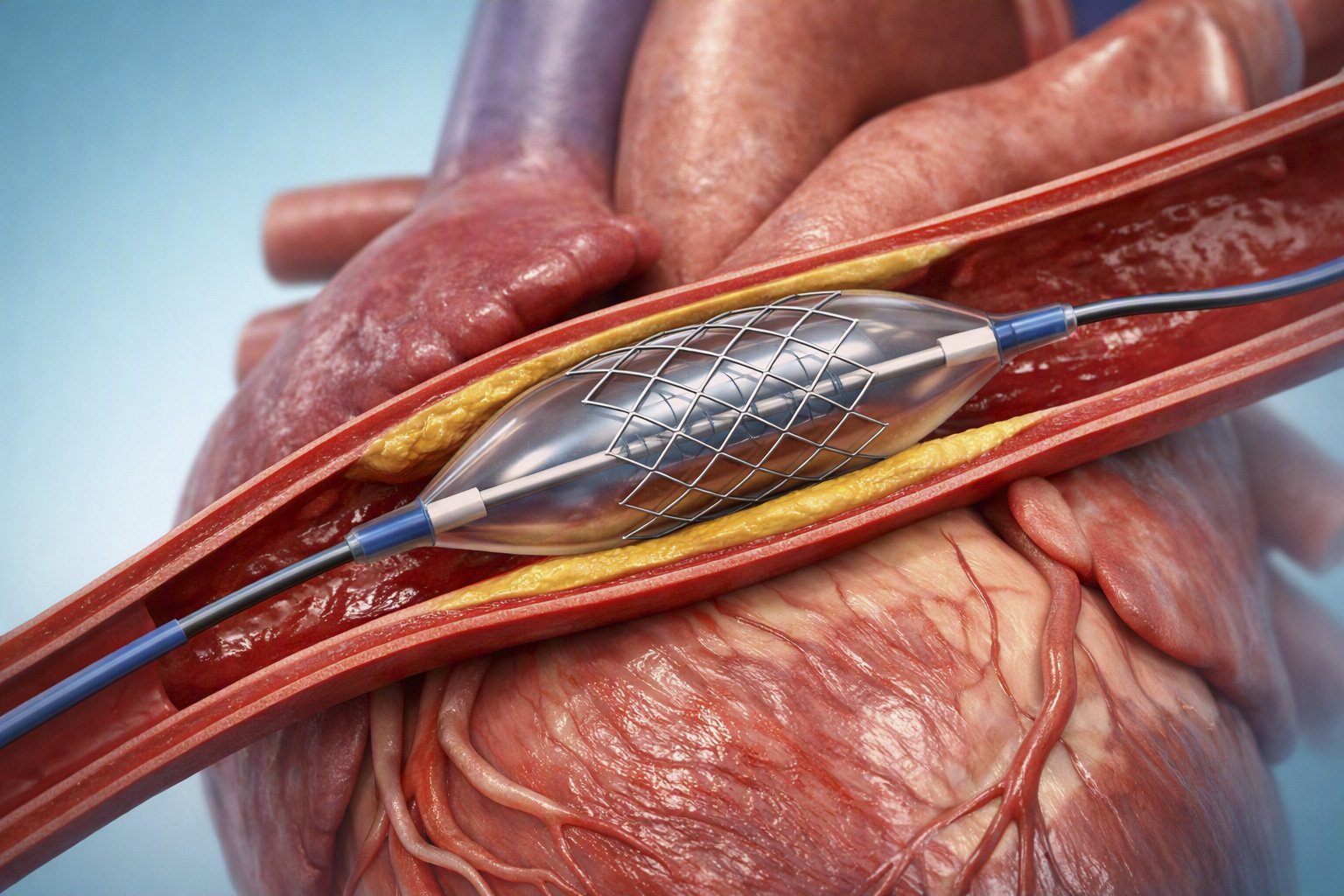
Per-Cutaneous Trans-Catheter Coronary Angioplasty: Angioplasty is a minimally invasive medical procedure used to open narrowed or blocked blood vessels and restore healthy blood flow using small balloon, usually followed by a stent.
About Angioplasty
Coronary Angioplasty (PTCA)
Procedure, Recovery & Care Guide
Coronary angioplasty is a minimally invasive medical procedure used to open narrowed or blocked heart arteries and restore healthy blood flow to the heart muscle. Its full medical term is Percutaneous Transluminal Coronary Angioplasty (PTCA).
Percutaneous: Performed through a tiny needle puncture in the skin, avoiding open surgery.
Transluminal: Performed from within the inside channel (lumen) of the blood vessel.
Coronary: Specifically targets the arteries supplying blood to the heart.
Angioplasty: The process of reshaping or opening up a blocked blood vessel.
Today, over 90% of angioplasty procedures involve placing a tiny mesh tube called a stent to keep the artery permanently open.
Why Do Heart Arteries Get Blocked? (Understanding CAD)
The heart relies on major coronary arteries for its oxygen and blood supply. Over time, plaque—made of cholesterol, calcium, and fatty tissue—builds up inside these artery walls, a condition known as atherosclerosis or coronary artery disease (CAD).
The Risk Factors: High blood pressure, diabetes, high LDL cholesterol, smoking, obesity, stress, and family history. (Note: In India, coronary artery disease often presents 5 to 10 years earlier than in Western countries).
Symptoms to Watch For: Chest pain or tightness (angyna), breathlessness during routine physical activities, unusual fatigue, or sweating.
Types of Angioplasty Procedures
Emergency Angioplasty (Primary PCI)
Performed immediately during a major heart attack (STEMI) when an artery is completely blocked. The goal is to open the vessel within a 90-minute "door-to-balloon" window to save critical heart muscle—hence the phrase "time is muscle".
Planned (Elective) Angioplasty
Scheduled when chronic chest pain persists despite medications, or diagnostic tests indicate that a critical blockage is starving a large portion of the heart muscle of blood.
Advanced Technology for Complex Blockages
For challenging cases, modern interventional cardiology utilizes advanced tools to ensure precision and long-term success:
Intravascular Imaging (IVUS & OCT): Tiny internal cameras measure exact artery dimensions.
Rotablation & IVL (Lithotripsy): Specialized diamond burrs or sound waves break down hard calcium calcifications.
Specialized Balloons & CTO Techniques: Designed to treat chronic or severely hardened blockages without major open-heart surgery.
Hospital Recovery & What to Expect
Monitoring: Vital signs, ECG, and the catheter insertion site (wrist or groin) are closely tracked for several hours.
Mobility: Patients treated via the wrist approach can usually sit up and eat within 1–2 hours.
Discharge: Planned cases typically return home the following day, while post-heart attack stays generally range from 3 to 5 days
Frequently Asked Questions
No, angioplasty is a minimally invasive procedure performed through a tiny puncture in the wrist or groin. It does not require opening the chest or stopping the heart.
While modern drug-eluting stents significantly reduce the risk, narrowing can sometimes re-occur over time (restenosis). Following medications, eating healthy, and regular check-ups help prevent this.