
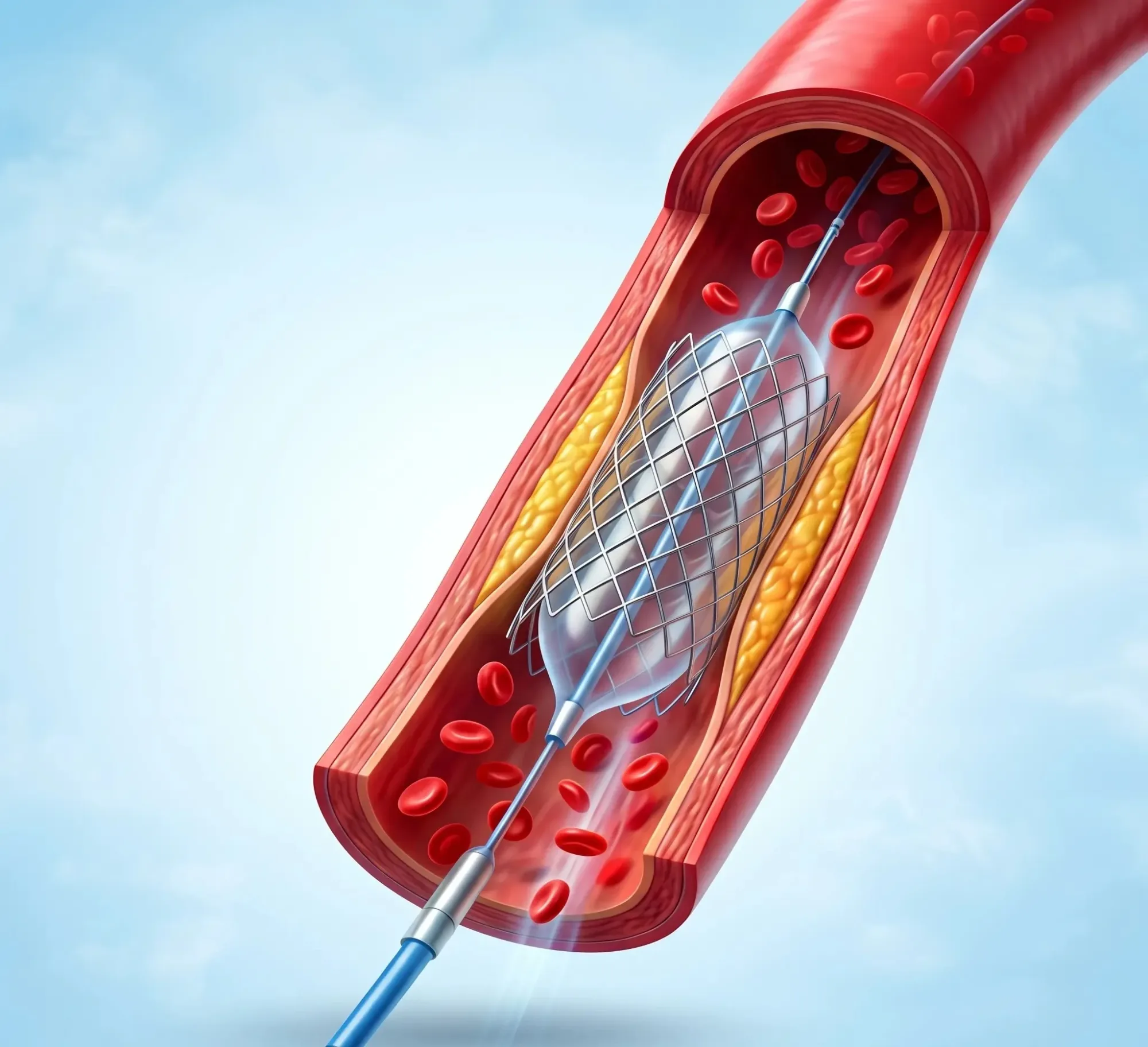
Coronary Stent Placement

Coronary stent placement is a minimally invasive procedure that uses a tiny, expandable mesh tube to support narrowed heart arteries. By keeping the blood vessel open, it ensures steady blood flow to the heart muscle, provides immediate relief from chest pain, and significantly reduces the risk of future heart attacks.
About Coronary Stent Placement
Coronary Stent Placement
A coronary stent is a tiny, expandable mesh tube placed inside a narrowed heart artery. It acts like an internal scaffold to hold the blood vessel open, ensuring your heart receives a continuous supply of oxygen-rich blood.
Why Is a Stent Needed?
Prevents Re-blocking : After an artery is cleared with a balloon, a stent prevents the vessel walls from collapsing or narrowing again.
Long-Term Support : Provides lasting structural support to keep blood flowing freely.
Reduces Heart Attack Risk : Stabilizes weak or diseased sections of the artery.
How It Works
Guided into Position : The stent is mounted in a collapsed state over a tiny balloon and guided to the blockage through the wrist or groin.
Expanding the Mesh : Once in place, the balloon is inflated. This expands the mesh tube until it presses firmly against the inner artery wall.
Permanent Placement : The balloon is deflated and removed. The stent remains permanently in your artery, and your body's natural cells gradually heal over it within a few weeks.
Types of Stents We Use
Drug-Eluting Stents (DES) : Coated with medication that slowly releases over time to prevent scar tissue from reforming inside the artery. This is the gold standard and most commonly used stent today.
Bare-Metal Stents : Uncoated mesh tubes used in select cases where patients cannot take long-term blood thinners.
Life After a Stent (Key Care Tips)
Never Stop Blood Thinners: Always take your prescribed blood-thinning medications (like Aspirin) daily. Stopping them early can cause a clot inside the stent.
Quick Recovery: Most patients resume light routine work within 3 to 5 days.
Lifestyle Matters: A stent opens the treated blockage, but a healthy diet, walking, and stress management protect the rest of your heart.
Frequently Asked Questions
Yes. Angioplasty is one of the most routinely performed cardiac procedures worldwide, with a success rate exceeding 95% in stable cases when managed by experienced interventional teams.
You will only feel a small pinch when the numbing injection is applied to the wrist or groin. You may experience a brief, mild sensation of pressure in your chest for a few seconds while the balloon is inflated, which subsides as soon as the balloon deflates.
The angioplasty procedure itself generally takes between 30 and 60 minutes, depending on the complexity, hardness, and number of blockages being treated.